
This post was originally published on this site.
To make a decent loaf of bread, you need three foundational things: flour, water and a baking tin. Leave out any one of them, and you end up with a mess on your kitchen countertop.
Sedimentary exhalative deposits, better known as SEDEX deposits, work much the same way. Take away the boardrooms, the capital expenditure projections, the political hype and the mining cycles, and these giant lead-zinc-copper systems boil down to an equally elegant recipe.
You need a source of metals, a deep salty fluid, a heat source, and somewhere waiting at the end, a chemical trap to force those metals out of solution into massive concentrations. It’s beyond speculation. Whenever those ingredients align, extraordinary deposits follow.
Ireland’s Navan became Europe’s largest zinc mine because hot saline fluids found the right carbonate host. Alaska’s Red Dog became one of the world’s richest zinc districts because metal-bearing brines hit chemically favourable sediments. Australia’s McArthur River transformed an entire basin into one of mining’s defining SEDEX provinces.
Even the Central African Copperbelt (although not a classic SEDEX system) demonstrates the same first-principles lesson. The world’s greatest copper and cobalt province was built because fluids, metals and reduction traps repeatedly met under the right basin architecture. The recipe itself matters more than the postcode.
And then there’s Ethiopia.
Ingredient 1 – The water
For much of its history, the Horn of Africa’s mineral conversation has revolved around gold and, more recently, potash. The headlines belong to the evaporites of the Afar Depression, and the narrow-vein, shear-hosted gold systems scattered across the Arabian-Nubian Shield. For those paying attention, the important word there is evaporites.
Evaporitic environments demonstrate this region’s ability to generate dense saline brines, the very fluids that sit at the heart of many of the world’s great sediment-hosted mineral systems. Those dense brines become the delivery system, carrying metals through kilometres of crust before eventually reaching the right chemical trap.
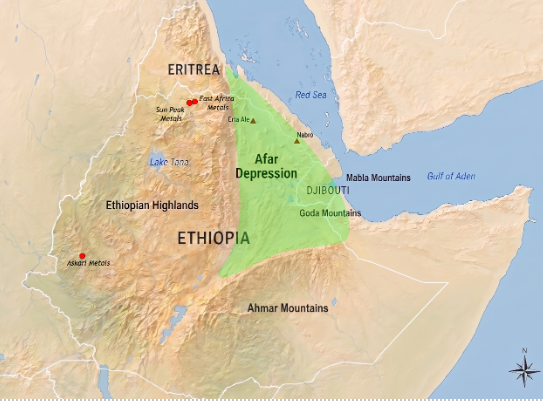
Map of Ethiopia showing the location and boundaries of the Afar (Danakil) Depression relative to the Ethiopian Highlands and surrounding Horn of Africa geography. Source: Author.
Ingredient 2 – The flour
A brine is only as good as what it carries. Otherwise, it’s just salty water. Fortunately, Ethiopia sits across one of Earth’s great tectonic laboratories. The Arabian-Nubian Shield preserves many Neoproterozoic volcano-sedimentary belts, whilst the East African Rift system provides exactly the kind of deep crustal plumbing capable of driving long-lived, metal-rich hydrothermal circulation.
In mature SEDEX systems, these dense salty brines circulate through volcanic rocks, red beds and basement lithologies, stripping copper, zinc and lead before moving upward along basin-scale faults. Ethiopia’s basement contains exactly that mixture of volcanic, intrusive and metamorphic rocks, repeatedly layered like an enormous, deformed cake, creating no shortage of structural pathways.
Ingredient 3 – The baking tin
The next ingredient is non-negotiable. Think of it as the bread baking tin, without which you simply can’t make the loaf. In geological terms, this is the reduction trap, the horizon where metal-rich brines suddenly become chemically unable to carry the metals, forcing them to dump out of solution as sulphides in enormous quantities, in a very conveniently concentrated way.
This reduction trap is almost always a carbonate or a carbonaceous shale. Of course, Ethiopia’s regional stratigraphy is littered with carbonate platforms and calcareous mudstones that sit directly over the Proterozoic basement. Where these carbonates meet the deep-sourced faults that tap into the basement, you have the exact theoretical contact point for an extraordinary chemical reaction. The metals are stripped from below, pushed upward, and trapped instantly when they hit the reduction trap.
The oven
Of course, bread still needs an oven. Fortunately, Ethiopia sits on one of the most geologically active pieces of continental crust on Earth. Although not your typical continental basin, the Afar Rift is one of the few places where we can watch the earliest stages of ocean formation happening almost in real time. More importantly, these modern systems are potentially a mirror of older basin structures across the region where these same hydrothermal processes operated on preserved sedimentary targets millions of years ago.
Better still, there’s proof that this plumbing has already worked before. At En Kafala, there are well documented iron-manganese-barium deposits that formed when the Afar Depression was connected to the Red Sea. The sequence is almost a textbook demonstration of exhalative behaviour: basaltic basement below, reef limestones above, hydrothermal fluids venting through the seafloor, before dropping out the metals in distinct layers. Sure, En Kafala is not a giant zinc deposit, but it proves that the oven works.
So why isn’t everyone talking about it?
If the geological recipe is so compelling, why isn’t every major miner piling into Ethiopia? Simply put, it’s because mining remains remarkably predictable.
Companies spend billions chasing each other around long-established basins, endlessly re-drilling known deposits and trying to one-up their peers with flashy (arguably unproven) AI technologies just to justify continued, single-cycle funding. Like it or not, it is an industry built on risk aversion disguised as innovation. That’s exactly what’s happening in Ethiopia.
Rather than testing whether the country’s older basin architecture could host giant sediment-hosted systems, today’s exploration is overwhelmingly focused on the exposed Arabian-Nubian Shield, where companies are chasing VMS copper-zinc deposits and shear-hosted gold systems.
Sun Peak Metals is exploring copper-zinc systems across northern Tigray, East Africa Metals is advancing the Harvest Project, and Askari Metals is revisiting copper discoveries around Nejo in western Ethiopia. None of that necessarily makes them wrong. It simply means almost everyone is asking the same geological question, yet not the one that actually matters.
But an even more interesting story is who stands to benefit if Ethiopia’s next major discovery comes from a play that hasn’t yet become fashionable. There is a very distinct pattern across these projects, a recurring pattern that has been seen and documented across much of Africa: Chinese capital, Chinese partnerships and Chinese strategic involvement that appear long before the headlines do. Zijin Mining’s backing of Harvest is the clearest example, but the pattern extends beyond upstream mining. It reaches into the infrastructure that would ultimately decide whether a future copper or zinc district becomes commercially viable.
Any large-scale base metal operation in Ethiopia eventually has to move concentrate, not just drill core. That means rail, ports and bulk logistics. The Ethio-Djibouti Railway, the country’s critical export artery, was financed predominantly by China, built to Chinese standards and runs directly to the deepwater Port of Doraleh, effectively linking Ethiopia’s future mineral exports to infrastructure that Beijing helped create. Even today, Chinese engineering firms continue providing technical support and operational expertise across the corridor.
And remember, all this is unfolding around a basin where the defining sediment-hosted discovery has not yet been made. If you’ve ever wondered how China repeatedly ends up sitting at the centre of critical mineral supply chains, this is it in real time! The mistake is assuming China is simply playing the same “Western” game, but more aggressively. Rather, it is operating from an entirely different strategic grammar altogether, where geology, infrastructure and capital are treated as parts of a single system rather than separate decisions.
While others debate narratives and wait for consensus to chase yesterday’s discovery, China is ruthlessly indifferent to both, choosing instead to follow geological logic. Not magical foresight, just steely clarity. Backing science before sentiment and funding exploration before certainty. If the ingredients are there, it deploys capital, builds infrastructure and de-risks the opportunity long before any major discovery is declared, because the reward is far greater than the risk.
The next great basin?
So, the remaining question is whether or not older basins have preserved the complete recipe. The evidence would suggest so, and that possibility deserves far more attention than it currently receives. If Ethiopia’s overlooked basins eventually deliver a major sediment-hosted base metal discovery, today’s exploration maps may look obvious in hindsight.
The clues are already scattered across volcanic belts, basement structures, carbonate successions and active hydrothermal systems. While many Western majors remain preoccupied with the “proven”, a handful of explorers have understood the geological setup. The geological kitchen is stocked and the recipe is proven. Those who understand the fundamental ingredients are sitting at the table, with China unmistakably positioned at the head, poised to capture yet another great African mining boom.
(Nicholas Vafeas is the founder and director of BluMelt Mineral Consulting Limited, an independent consultancy specialising in geological assurance, critical minerals and investment de-risking)


